ABOUT THE AUTHORS
"Free speech and Freethought go together. If one is
hampered the other languishes. What is the use of thinking if I may not
express my thought? We claim equal liberty for all. The priest shall say
what he believes and so shall the sceptic. No law shall protect the one
and disfranchise the other. If any man disapproves what I say, he need
not hear me a second time. What more does he require? Let him listen to
what he likes, and leave others to do the same. Let us have justice and
fair play all round."
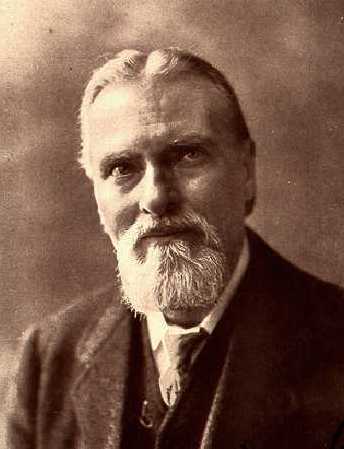 George
William Foote was born in Plymouth, England on 11 January 1850. In
his youth he became a freethinker through reading and independent thought.
When he came to London in 1868 he joined the freethought organisations
that were flourishing at the time. Foote was soon lecturing at freethought
meetings. Charles Bradlaugh, then the leader of the secularist movement,
soon recognised Foote's abilities and allowed him to play an increasingly
important role in the British freeethought movement. Foote contributed
many articles to Bradlaugh's National Reformer and in 1876 founded
his own magazine, The Secularist. This was followed by his major
publishing success, The
Freethinker, which began in 1881 and is still in existence
today.
George
William Foote was born in Plymouth, England on 11 January 1850. In
his youth he became a freethinker through reading and independent thought.
When he came to London in 1868 he joined the freethought organisations
that were flourishing at the time. Foote was soon lecturing at freethought
meetings. Charles Bradlaugh, then the leader of the secularist movement,
soon recognised Foote's abilities and allowed him to play an increasingly
important role in the British freeethought movement. Foote contributed
many articles to Bradlaugh's National Reformer and in 1876 founded
his own magazine, The Secularist. This was followed by his major
publishing success, The
Freethinker, which began in 1881 and is still in existence
today.
In 1882 Foote was charged with blasphemy for having published a number of
biblical cartoons in The Freethinker. These had been modelled
after a series of French cartoons that had appeared earlier. After a
series of trials Foote was found guilty in 1883 and sentenced to twelve
months' imprisonment by Justice North, a Catholic judge. ("The sentence is
worthy of your creed," Foote responded.) The Freethinker
carried the banner headline "Prosecuted for Blasphemy" during this period,
probably increasing its sales.
When Foote was released from prison, he was a hero in freethought
circles. He continued writing, lecturing, and editing magazines until
Charles Bradlaugh died in 1891. At that time Foote was elected to lead the
National Secular
Society, founded by Bradlaugh. Foote continued in this role until
his death on 17 October 1915.
Joseph Mazzini Wheeler was born in London on 24 January 1850. In
his youth he was converted from Christianity by reading the works of
Newman, Mill, Darwin, Spencer, and others. He became a close friend of G.
W. Foote, and in 1882 was appointed sub-editor of The Freethinker,
a position he was to hold for many years. When Foote was imprisoned for
blasphemy in 1883 Wheeler took over as acting editor. The strain of the
trial, Foote's imprisonment, and Wheeler's increased editorial duties
proved too much for his delicate health, and he suffered a nervous
breakdown. He was sent away to recuperate and recovered quickly.
Wheeler had an extensive knowledge of the history of freethought.
In his Biographical Dictionary of Freethinkers (1889) he modestly
described himself as "a willing drudge in the cause he loves" who "hopes
to empty many an inkstand in the service of freethought." Sadly, his
early death on 5 May 1898 (following another breakdown) meant that his
projected History of Freethought in England was never completed.
SOURCES:
FURTHER READING
Online Resources (off-site):
Infidels
Deathbeds, revised and expanded edition (1933?) of a work
originally published by Foote in 1886.
History of the British Secular Movement (1948) by John E.
McGee. Includes a Foote bibliography.
Did
Jesus Live 100 B.C.? (1903) by G.R.S. Mead (1863-1933).
Includes another version of the Sepher Toldoth Jeshu.
Offline Resources:
The
Bible Handbook by G.W. Foote & William P. Ball.
Revised and expanded edition of the 1888 original.
The
Jesus the Jews Never Knew: Sepher Toldoth Yeshu and the Quest of the
Historical Jesus in Jewish Sources (2003), by Frank Zindler.
Incorporates Foote's edition of The Jewish Life of Christ.
Word
Crimes: Blasphemy, Culture, and Literature in Nineteenth-Century
England (1998), by Joss Marsh.